Best of Retail Media
Colruyt Group Retail Media Services
Lillet wanted to grow the penetration of Lillet Rosé at the peak of the summer aperitif season. Not more purchases from the people who already drink it, but more people drinking it.
Penetration and reach are what build a brand and its business. The question was where to build them: the budget did not cover the full Colruyt Lowest Prices network, so the campaign had to choose its stores, and choose them on evidence rather than on habit.
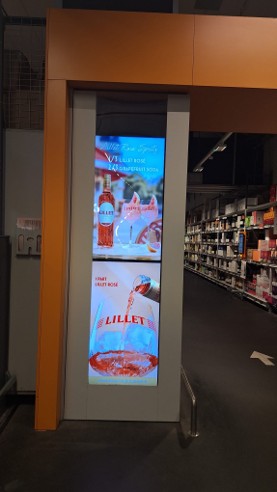
Let the business data pick the stores. Colruyt Group transaction data ranks every Colruyt Lowest Prices store on its sales in the aperitif category. The 70 highest performing stores were selected, (roughly a quarter of the total network. Digital signage ran at their entrance gate for two weeks at the peak of the season, with full weight in each of them.
The targeting sat in the context, not in a customer segment. For a penetration objective, the people worth reaching are precisely those the brand does not know yet, so no customer-level selection was applied. The plan went where the category is bought instead: the stores where aperitifs sell most, and the Drinks and Aperitif section of the Colruyt Lowest Prices website, where a category banner addressed shoppers browsing the range.
Two contexts, one logic: put a limited budget where the category already performs, and measure who bought as a result. The store screen delivered the bulk of the reach; the banner covered the same category context on site.
The Lillet campaign is a powerful example of how smart Retail Media turns visibility into measurable growth. By combining online activation with data-led Digital Signage in high-performing stores, Lillet delivered an impressive +81% sales uplift, while recruiting 69% new-to-brand buyers. Relevance, timing and measurable impact made the difference.
Store selection on business data, measurement on identified buyers. Two things made this plan possible.
It is what turns a store screen from an awareness format into a recruitment channel with a verifiable outcome, and what turns store selection from a media buy into a return-on-budget decision.
Because Colruyt Group recognises more than 83% of in-store transactions, a store screen can be planned on net reach and judged on who it recruited. Exposure and purchase sit in the same dataset, on the same identified people.
Lillet put a limited budget on 70 stores, one reference, two weeks and one screen position, and let the category data decide which 70. The whole plan rested on the in-store screen and a category banner, with no customer segment to fall back on: if the store selection was wrong, nothing else in the plan would compensate.
The second bet was on the yardstick. Judging the campaign on who it recruited rather than on how much it sold is a harder test to pass, and the right one for a brand whose objective is penetration.
The campaign recruited nearly seven buyers in ten had never bought Lillet Rosé before. Almost one in ten were lapsed buyers who had not purchased the product for at least two years. Close to eight buyers in ten were therefore either new to the brand or brought back to it.
The reactivation figure is worth isolating. Those shoppers had bought Lillet before and stopped. They came back because the brand was present at the entrance of the stores where aperitifs are bought most, at the moment of the season when they are bought.
The right stores, saturated
The 70 selected stores represent roughly a quarter of the Colruyt Lowest Prices network and were chosen on their aperitif category sales. Within them, more than seven shoppers in ten were reached over the two weeks: 411,054 identified shoppers, at a real frequency of 1.74 counted per person rather than modelled on footfall. Selecting the stores on business data put the budget where the category buyers are, and the budget bought saturation there.
And sales followed
Sales of Lillet Rosé rose 81% during the campaign window, measured on the exposed shoppers rather than on total store sell-out.
Scope
One reference, two weeks, 1 to 14 July 2026, Colruyt Lowest Prices.
Store selection and audience
The 70 Colruyt Lowest Prices stores were selected on their historical sales in the aperitif category, from Colruyt Group transaction data. Targeting was contextual: store selection in store, placement in the Drinks and Aperitif section on site. No customer-level segmentation was applied; the campaign addressed all shoppers of the selected stores and all visitors of the category section. Results describe those 70 stores and should not be read as a network-wide figure.
Reach and frequency
Net contacts are unique identified customers exposed to a touchpoint during the flight. Gross contacts are total exposures. Frequency is gross divided by net, counted per person rather than modelled on footfall. In-store exposure is attributable because more than 83% of in-store transactions are matched to an identified customer.
Sales uplift
Campaign period compared with the two weeks preceding it, on Colruyt Group transaction data, measured on the shoppers exposed to the campaign. This is a pre versus post measurement, not a control group design, and the campaign ran at the start of the summer aperitif season, so part of the movement is seasonal. Control group methodology is being implemented for the next campaign wave.
New to brand and reactivated
New to brand: customers with no recorded purchase of the reference before the campaign who bought it during the campaign period. Reactivated: customers who had purchased the reference in the past but not during the two years preceding the campaign, and who bought again during the campaign. Both are expressed as a share of total buyers over the campaign period.